CEFI: A beginner’s road to internationalization
Fernando P. Tiu Jr.
Director, Marketing and Promotions
Calayan Educational Foundation, Inc.
It would be safe to say that Calayan Educational Foundation, Inc. (CEFI) managed the first 40 or so years of its existence in relative isolation. Partnerships with other educational institutions, industries, and organizations were limited to what was deemed necessary at the time; just enough to comply with requirements set by the Commission on Higher Education, and later with the standards set forth by accrediting bodies such as the Philippine Association of Colleges and Universities Commission on Accreditation (PACUCOA).
Over the last decade, we have witnessed the trend towards internationalization among Philippine HEIs, intensifying particularly in the post-Pandemic era. Global partnerships, the pressure of international rankings, alignment with sustainable development goals, among others were all alien to CEFI at the time.
However, the tide of internationalization is, in the words of the Great Thanos of the Marvel lore, inevitable. Moreover, internationalization-related programs, standards, etc. are themselves slowly-but-surely becoming part of the requirements of CHED and accrediting agencies. Despite excelling within the confines of its present sphere, CEFI had no choice but to break out and sail into these uncharted waters.
From there, CEFI stumbled into the first challenge encountered by fledgling HEIs in the road to internationalization: getting noticed. While CEFI indeed made a name for itself among Philippine HEIs, particularly in the field of health education, it must be confessed that its shine still paled in comparison to those of the most prestigious institutions in the country. HEIs hopping into the internationalization wave naturally gravitate towards other HEIs that can boost their prestige, and provide them with benefits commensurate to what they themselves can offer.
Because of this, HEIs are wary of other institutions who would just assume a parasitical role in an otherwise mutually-beneficial partnership. While this may sound harsh, and while HEIs are free to deny this discriminative practice, this is the reality. And so CEFI found itself having to constantly prove what it can bring to the table.
Ironically, CEFI at the same time must remain vigilant and discerning in its choice of partners, lest it constantly end up with the shorter end of the stick in these alliances. One cannot be so naïve to fail to see that in this chaotic surge towards internationalization, there are not a few institutions who are in it for merely the clout and one-sided benefit. These less-than-scrupulous entities pose a threat that can undermine the essence and purpose of internationalization.
Given these, CEFI faces additional challenges like having to evaluate itself against new and even-higher standards associated with internationalization, and respond to these demands. Otherwise, it will just get caught up in the chicken-or-the-egg conundrum where in order to benefit from internationalization, one must first be at par with international standards. By standards, one does not only mean universally-accepted benchmarks such as UN’s SDG, but also standards imposed by international ranking institutions (that only seem to be growing in number), not to mention the demands of the partnering institutions themselves. CEFI, like other HEIs venturing into this trend, has to somehow navigate these varying and at times conflicting standards, and somehow figure out which ones to prioritize because there is only so much resource to go around. As the saying goes, “one who chases two rabbits catches neither.”
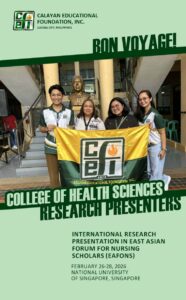
Fortunately for humbler institutions like CEFI, change and improvement do not always need to be drastic; they can be gradual yet consistent, and guided. Finally, in September of 2023, CEFI was able to ink its first international partnership with Indonesia’s Universitas Sarjanawiyata Tamansiswa (UST). This union opened the doors for CEFI particularly in terms of research collaboration and publication opportunities. CEFI got its first taste of participating in an international research conference. Soon enough, CEFI took on the role of event partner, with its faculty being entrusted with evaluating research competition entries.
In January of 2024, CEFI landed another partnership, this time with Huachiew Chalermprakiet University (HCU) of Thailand. Like the partnership with UST, this also provided opportunities for research presentation and publication in international journals. Beyond that, the strength of this partnership lies in student mobility programs. CEFI has already sent over 200 Nursing, Medical Technology, and Criminology students to HCU for month-long trainings. Students were exposed to equipment and facilities that are considered a rarity among Philippine HEIs such as DNA and various forensic labs. Moreover, HCU graciously showed CEFI the ropes regarding international ranking, which the latter is now actively pursuing.
In June of 2024, CEFI secured partnerships with training and employment firms based in Germany, namely Care Beyond Borders (CBB) Global Recruitment GmbH, and Pro Civitate. These partnerships allowed CEFI nursing and other health education students direct access to the growing demand for healthcare manpower not only in the said country, but also throughout Europe.
While starting the internationalization journey can be slow for most HEIs, one good thing is that once a foothold is gained, opportunities to partner with even more institutions come knocking in. Through CEFI’s involvement with UST in Indonesia, partnership is now being explored with Dong Nai Technology University of Vietnam, as well as with the Universiti Teknologi MARA in Malaysia.
Engaging in international partnerships is also a good way to build and strengthen local partnerships. In September of 2024, CEFI inked yet another milestone alliance, this time with the World Citi Colleges (WCC) in Quezon City. The Memorandum of Understanding (MOU) covers curricular enhancement, student internships, faculty and student exchanges, and joint research projects. It also encompasses joint seminars, training sessions, and conferences, aimed at facilitating knowledge-sharing and resource exchange.
Today, CEFI finds itself growing at an even more rapid phase than before, thanks in no small measure to the impetus provided by contribution and guidance of its international partners, as well as the sheer, insatiable will of CEFI itself to consummate its mission to develop holistic, self-fulfilling, and productive citizens, actively engaged in national and international development, imbued with the values of honor, scholarship, and service, deeply committed to raising the quality of man’s life.